
How to Become an AI Engineer: Skills, Career Path, and Job Guide
Artificial Intelligence is becoming an important part of modern software, business automation, data analysis, and digital products. As companies adopt AI technologies, the demand for professionals who can develop and implement intelligent applications is also growing.
One of the career paths in this field is AI Engineering. An AI Engineer combines programming, data, machine learning, and software development to build applications that can analyze information, recognize patterns, generate content, or automate specific tasks.
If you are a student, fresher, software developer, or technology professional interested in Artificial Intelligence, understanding what an AI Engineer does and how to become one can help you plan your learning journey.
What Is an AI Engineer?
An AI Engineer is a technology professional who develops and integrates Artificial Intelligence solutions into software applications and business systems.
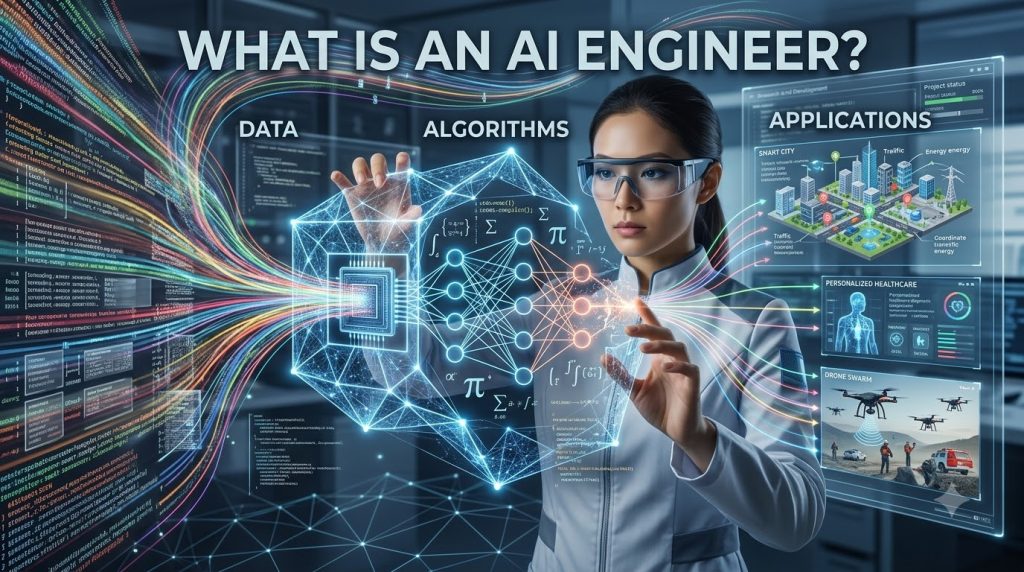
AI Engineers may work with:
- Artificial Intelligence
- Machine Learning
- Generative AI
- Python
- Data processing
- Computer Vision
- Natural Language Processing
- APIs
- Databases
- Cloud platforms
- Software development
The role is usually practical. Instead of only studying AI concepts, an AI Engineer works on turning those concepts into working applications and solutions.
For example, an AI Engineer may develop a chatbot, integrate an AI model into a web application, create a computer vision system, or build a machine learning solution for business data.
What Does an AI Engineer Do?
The daily responsibilities of an AI Engineer can vary depending on the company and project.
Some common responsibilities include:

Developing AI Applications
AI Engineers create applications that use Artificial Intelligence to perform specific tasks.
Examples include:
- AI chatbots
- Recommendation systems
- Prediction applications
- Document-processing tools
- AI assistants
- Image analysis systems
- Automated reporting applications
Working With Data
AI applications often depend on data. Engineers may need to collect, clean, process, and prepare data before using it.
This can involve:
- Removing incorrect data
- Handling missing values
- Organizing datasets
- Converting data into useful formats
- Analyzing patterns
Building Machine Learning Models
AI Engineers may develop or integrate machine learning models for tasks such as:
- Classification
- Prediction
- Pattern recognition
- Forecasting
- Recommendation
They also test models to understand how well they perform.
Integrating AI Into Software
An AI model becomes more useful when it can be connected to an actual application.
An AI Engineer may integrate AI into:
- Websites
- Mobile applications
- Business software
- Dashboards
- Automation systems
- Cloud applications
Testing and Improving AI Systems
AI systems need testing after development.
Engineers may evaluate:
- Accuracy
- Response quality
- Processing time
- Reliability
- User experience
Based on testing, the application can be improved.
AI Engineer vs Data Scientist
AI Engineers and Data Scientists can work closely together, but their responsibilities are not always the same.
| Area | AI Engineer | Data Scientist |
|---|---|---|
| Main Focus | Building AI-powered applications | Analyzing data and developing insights |
| Programming | High | High |
| Machine Learning | Important | Important |
| Software Development | Major part of the role | May be less central |
| Data Analysis | Required | Major part of the role |
| Deployment | Often involved | May collaborate with engineering teams |
| AI Applications | Strong focus | Can be part of the work |
The actual responsibilities can vary between organizations, so job descriptions should always be checked carefully.
Skills Required to Become an AI Engineer
You do not need to learn every AI technology at once. A structured learning path can make the process easier.
1. Python Programming
Python is one of the most useful languages for AI development.
Start with:
- Variables
- Data types
- Conditions
- Loops
- Functions
- Lists and dictionaries
- File handling
- Modules
- Basic OOP
After learning the fundamentals, you can move toward Python libraries used for data and AI.
2. NumPy and Pandas
Data processing is an important part of AI development.
NumPy is useful for numerical operations, while Pandas is commonly used for working with structured datasets.
You should understand how to:
- Read datasets
- Filter data
- Clean data
- Transform data
- Analyze basic patterns
3. Machine Learning
Machine Learning provides the foundation for many AI applications.
Important concepts include:
- Supervised learning
- Unsupervised learning
- Regression
- Classification
- Clustering
- Model evaluation
- Training and testing
You should focus on understanding how these techniques are applied to real problems rather than memorizing algorithms.
4. Generative AI
Modern AI engineering increasingly includes applications built around Generative AI.
You can learn how AI systems are used for:
- Text generation
- Question answering
- Summarization
- AI assistants
- Document analysis
- Content generation
- Coding assistance
Understanding how to integrate AI capabilities into software is especially useful for application-focused AI roles.
5. Computer Vision
Computer Vision allows software to work with images and videos.
An AI Engineer can use Computer Vision for:
- Object detection
- Image classification
- Face detection
- Video analysis
- Visual inspection
OpenCV is one example of a technology used for computer vision development.
6. Natural Language Processing
NLP focuses on processing and understanding human language.
Applications include:
- Sentiment analysis
- Text classification
- Chatbots
- Text summarization
- Information extraction
NLP can be combined with Generative AI to create useful language-based applications.
Do You Need Mathematics to Become an AI Engineer?
Mathematics is useful for understanding machine learning and AI concepts, but beginners do not need to start with advanced mathematics.
A practical foundation can include:
- Basic algebra
- Statistics
- Probability
- Mean, median, and standard deviation
- Basic linear algebra concepts
As your AI knowledge grows, you can learn more mathematical concepts when they become relevant to your projects.
For job-oriented learning, it is useful to balance theory with programming and practical implementation.
Do You Need Coding to Become an AI Engineer?
Yes. Programming is an important part of AI Engineering.
AI Engineers need to write code to:
- Process data
- Build applications
- Integrate AI models
- Create APIs
- Automate workflows
- Test applications
- Connect different software components
For beginners, Python is a practical starting point.
AI Engineer Career Path for Freshers
Freshers can follow a gradual learning path rather than trying to learn everything simultaneously.
A practical roadmap is:
Step 1: Learn Python
Understand programming fundamentals.
Step 2: Learn Data Handling
Work with datasets using tools such as NumPy and Pandas.
Step 3: Learn Data Visualization
Understand how to present data and identify patterns.
Step 4: Learn Machine Learning
Study basic machine learning concepts and build small models.
Step 5: Explore Generative AI
Learn how modern AI applications can be integrated into software.
Step 6: Choose a Specialization
You can explore areas such as:
- Computer Vision
- NLP
- Machine Learning
- Generative AI
- AI automation
Step 7: Build Projects
Create practical applications that demonstrate your skills.
Step 8: Build a Portfolio
Publish suitable projects on GitHub and prepare a professional resume.
AI Engineer Projects for Students
Projects are an important part of learning Artificial Intelligence.
Some beginner and intermediate project ideas include:
AI Chatbot
Create a chatbot that can answer questions from a defined knowledge base.
Sentiment Analysis
Build an application that analyzes text and identifies sentiment.
AI Report Generator
Create a system that processes data and generates a structured report.
Computer Vision Application
Develop an application that detects or analyzes objects in images or videos.